




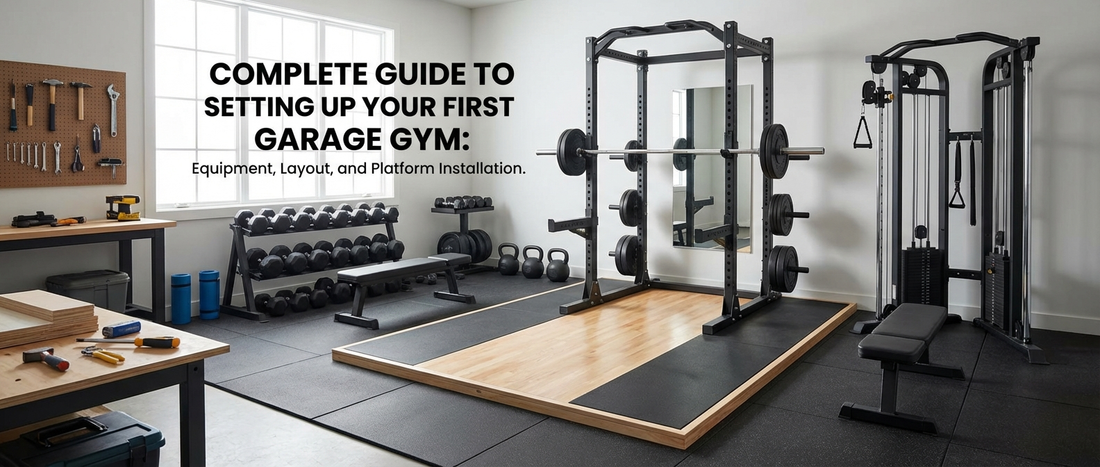
Complete Guide to Setting Up Your First Garage Gym: Equipment, Layout, and Platform Installation
Share
What equipment do you need for your first garage gym?
Your first garage gym needs four essential pieces: a power rack ($400-800), Olympic barbell ($100-200), weight plates (300-400 pounds, $200-400), and an adjustable bench ($150-300). These basics cover 90% of strength training exercises and cost $850-1,700 total. Add cardio equipment like the StairMaster HIIT Air Bike for complete workouts.
Building a garage gym is exciting, but the equipment choices can feel overwhelming. Start with compound movement tools that work multiple muscle groups, then expand based on your specific goals.
Essential Strength Equipment
- Power Rack: The foundation of any garage gym. Look for 11-gauge steel construction with safety bars rated for 700+ pounds
- Olympic Barbell: 45-pound standard barbell with 28-29mm grip diameter for comfortable handling
- Weight Plates: Start with pairs of 45, 25, 10, 5, and 2.5-pound plates. Iron plates cost less than bumper plates
- Adjustable Bench: Choose one that adjusts from flat to 85-degree incline for versatility
- Rubber Flooring: 3/8" to 3/4" thickness protects your garage floor and equipment
Smart Cardio Additions
Cardio equipment transforms your garage from a weight room into a complete fitness center. Consider these space-efficient options:
The StairMaster HIIT Air Bike offers exceptional value at $1,195. It provides full-body cardio workouts in just 4 square feet of space, making it perfect for garage gyms with limited room.
How do you design an efficient garage gym layout?
Effective garage gym layouts follow the "zones" principle: strength zone (power rack area), cardio zone (treadmill/bike space), and storage zone (plates, accessories). Allow 8x8 feet for your power rack, 6x3 feet for cardio equipment, and 4x4 feet for storage. This arrangement uses a standard two-car garage efficiently.
Single-Car Garage Layout (10x20 feet)
Single-car garages require strategic planning. Place your power rack along the longer wall, leaving the center open for floor exercises. Mount storage on walls to maximize floor space.
| Area | Equipment | Space Required |
|---|---|---|
| Strength Zone | Power rack, barbell, plates | 8x8 feet |
| Cardio Zone | Air bike or compact equipment | 4x4 feet |
| Storage | Wall-mounted racks | Wall space only |
Two-Car Garage Layout (20x20 feet)
Two-car garages offer luxury space for complete home gyms. Create distinct zones while maintaining traffic flow between areas.
How do you install a garage gym platform?
A garage gym platform requires 3/4" plywood base, 3/4" stall mats on top, and proper measurements for your space. Cut two 4x8 plywood sheets to your desired size, secure them together with construction adhesive and screws, then top with rubber stall mats. Total cost runs $150-300 for an 8x8 platform.
Platform Materials and Tools
- Base Layer: Two 4x8 sheets of 3/4" plywood ($60-80 each)
- Top Layer: Four 4x6 rubber stall mats, 3/4" thick ($40-50 each)
- Fasteners: Construction adhesive and 2" wood screws
- Tools: Circular saw, drill, measuring tape, chalk line
Step-by-Step Installation
Step 1: Measure your space and decide on platform size. Most garage gyms use 8x8 feet, providing enough space for deadlifts and Olympic lifts.
Step 2: Cut plywood sheets to size if needed. Standard 4x8 sheets work for most applications, but you might need custom cuts for odd-shaped spaces.
Step 3: Apply construction adhesive between plywood layers in a zigzag pattern. Screw sheets together every 12 inches around the perimeter and throughout the center.
Step 4: Position rubber mats on top of the plywood base. Stall mats from farm supply stores offer the best value at $40-50 per 4x6 mat.
Step 5: Trim mats with a sharp utility knife if needed. Work slowly and replace blades frequently for clean cuts.
What about climate control and electrical needs?
Garage gyms need temperature control and proper electrical setup for year-round use. Install a mini-split system ($800-1,500) for heating and cooling, ensure adequate lighting (LED shop lights work great), and add GFCI outlets for equipment requiring power.
Essential Climate Considerations
Texas garages get extremely hot in summer, making climate control crucial for consistent workouts. Budget $100-200 monthly for cooling costs during peak summer months.
How much does a complete garage gym setup cost?
A complete garage gym costs $2,000-5,000 for quality equipment, platform, and basic climate control. Budget setups start around $1,200 with used equipment, while premium setups with commercial-grade remanufactured equipment reach $8,000-12,000. Factor in ongoing costs like electricity and equipment maintenance.
Budget Breakdown by Category
- Essential Equipment: $1,200-2,500 (rack, bar, plates, bench)
- Platform Installation: $200-400 (materials and tools)
- Flooring: $300-800 (rubber mats for entire space)
- Climate Control: $800-2,000 (mini-split system)
- Cardio Equipment: $1,000-3,500 (optional but recommended)
- Storage Solutions: $200-600 (wall racks, hooks, shelving)
Professional-grade equipment like the Life Fitness CLST Integrity Series Treadmill costs significantly less when remanufactured ($2,195) compared to new commercial units ($6,000+).
Frequently Asked Questions
Do I need permits to convert my garage into a gym?
No permits are required for personal gym equipment installation in most Texas cities. You're not changing the structure or electrical systems permanently. However, check local HOA restrictions on garage modifications.
How do I prevent equipment rust in a humid garage?
Control humidity with a dehumidifier, apply protective coatings to iron equipment, and ensure proper ventilation. Stainless steel and powder-coated equipment resists rust better than raw iron.
Can garage gym equipment damage my concrete floor?
Rubber flooring and platforms prevent concrete damage from dropped weights. Without protection, heavy deadlifts and dropped plates will crack concrete over time. Invest in proper flooring from the start.
Is remanufactured gym equipment reliable for home use?
Yes, professionally remanufactured commercial equipment often outlasts new consumer-grade equipment. Commercial machines are built for 8-12 hours daily use, making them incredibly durable for home applications.
How much space do I need for a functional garage gym?
A 10x10 area provides enough space for basic strength training. However, 12x12 or larger allows comfortable movement and multiple exercise stations. Consider ceiling height too – you need 8+ feet for overhead movements.


