





Building a Competition-Ready Home Gym: Equipment That Supports Serious Training Goals
Share
What makes a home gym competition-ready?
A competition-ready home gym requires commercial-grade equipment that can handle intense, high-volume training without breaking down. Unlike casual fitness setups, serious competitors need machines with precise resistance systems, durability ratings above 4+ hours daily use, and features that support progressive overload. The key difference is investing in remanufactured commercial equipment rather than consumer-grade alternatives.
Building a competition-ready space isn't about having the most equipment—it's about having the right equipment that supports your specific training demands and competitive goals.
How much should you budget for competition-level home gym equipment?
Plan to invest $8,000-$15,000 for a competition-ready home gym with commercial-grade equipment. Remanufactured commercial machines offer 40-60% savings over new while maintaining professional gym quality. A basic setup starts around $5,000, while comprehensive competition facilities can exceed $20,000.
The investment pays off through consistent training access, no gym membership fees, and equipment that holds its value. Competition-focused lifters often recoup costs within 2-3 years through saved membership fees and travel time.
Which cardio equipment do serious competitors need?
Serious competitors require cardio equipment that supports both steady-state and high-intensity interval training with precise heart rate monitoring and resistance control. Commercial-grade machines offer superior biomechanics and durability for daily use during prep phases.
Essential Cardio Equipment for Competition Prep
- Commercial Treadmills: The Life Fitness CLST Integrity Series Treadmill provides precise incline control and shock absorption for high-volume cardio sessions
- Elliptical Trainers: Full-body engagement with the Precor EFX 835 Total Body Elliptical Trainer for joint-friendly cardio
- Air Bikes: The StairMaster HIIT Air Bike delivers unlimited resistance for brutal conditioning sessions
- Adaptive Motion Trainers: Variable stride patterns with the Precor AMT-12 865 Adaptive Motion Trainer prevent overuse injuries
What strength equipment supports competition training?
Competition-ready strength training requires equipment that supports heavy loads, precise movements, and progressive overload. Focus on foundational pieces that accommodate multiple exercises rather than single-purpose machines.
Core Strength Equipment Priorities
- Power Rack/Cage: Must support 1,000+ lbs with safety bars and pull-up capability
- Olympic Barbell Set: Competition-spec bars (45 lbs) with calibrated plates
- Adjustable Bench: Commercial-grade with 0-90 degree adjustment and 800+ lb capacity
- Cable System: Dual adjustable pulleys for isolation work and rehabilitation
- Dumbbells: Either adjustable commercial sets or fixed weights up to 100+ lbs
The key difference between competition and casual equipment is load capacity and precision. Competition lifters regularly handle near-maximal weights—equipment must accommodate personal records plus room for growth.
How do you optimize space for competition training?
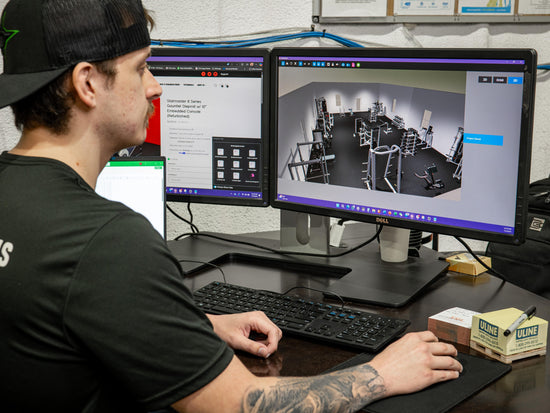
Efficient space utilization maximizes training variety within limited square footage. Plan for 200-400 square feet minimum, with 8-foot ceilings for overhead movements. Design workflow patterns that minimize equipment changes between exercises.
Space Planning Strategies
- Central Power Station: Position rack/cage centrally for easy access
- Cardio Corner: Place cardio equipment near windows for natural light and ventilation
- Floor Space: Maintain 8x8 feet minimum for stretching, core work, and functional movements
- Storage Solutions: Wall-mounted plate storage and accessory organization
- Mirror Placement: Full-wall mirrors for form checking and psychological benefits
| Space Size | Equipment Capacity | Training Style |
|---|---|---|
| 200-300 sq ft | Essential strength + 1 cardio | Basic competition prep |
| 300-500 sq ft | Full strength + 2 cardio options | Complete competition training |
| 500+ sq ft | Multiple stations + specialty equipment | Professional-level facility |
What environmental factors affect competition training?
Environmental control significantly impacts training quality and consistency. Temperature, humidity, lighting, and ventilation all influence performance and recovery during intense preparation phases.
Critical Environmental Considerations
- Temperature Control: Maintain 65-72°F for optimal performance
- Ventilation: Adequate airflow prevents overheating during high-intensity sessions
- Lighting: Bright, even lighting improves form and motivation
- Flooring: Rubber flooring for noise reduction and equipment protection
- Sound System: Quality audio for motivation and workout timing
How do you maintain commercial equipment at home?
Remanufactured commercial equipment requires minimal maintenance when properly cared for. Establish weekly cleaning routines, monthly lubrication schedules, and annual professional inspections to ensure peak performance throughout competition seasons.
Maintenance Schedule
- Daily: Wipe down surfaces, check for loose bolts
- Weekly: Deep clean, inspect cables and belts
- Monthly: Lubricate moving parts, calibrate electronics
- Annually: Professional inspection and service
Frequently Asked Questions
Is remanufactured equipment reliable for competition training?
Yes, professionally remanufactured commercial equipment offers the same performance and durability as new machines. CTX Home Gyms' remanufactured equipment undergoes complete rebuilds with new wear parts, ensuring reliability for intense competition preparation.
How much space do I need for a competition-ready home gym?
Minimum 200 square feet for basic competition training, though 300-400 square feet is ideal. This allows for proper equipment spacing, safe movement patterns, and adequate ventilation during high-intensity sessions.
What's the most important equipment investment for competitors?
A high-quality power rack or squat cage should be your first investment. It supports the most fundamental competition movements (squats, bench press, rows) and provides safety for training alone during intense prep phases.
Can I compete successfully training only at home?
Absolutely. Many successful competitors train exclusively at home with proper equipment. The consistency, convenience, and personalized environment often produce better results than commercial gym training with crowds and equipment waits.
How do I know if commercial equipment will fit in my space?
Measure your space carefully and add 3 feet clearance around each machine for safe operation. Most commercial cardio equipment requires 8-foot ceilings and 7x4 feet floor space minimum. Always verify dimensions before purchasing.


