




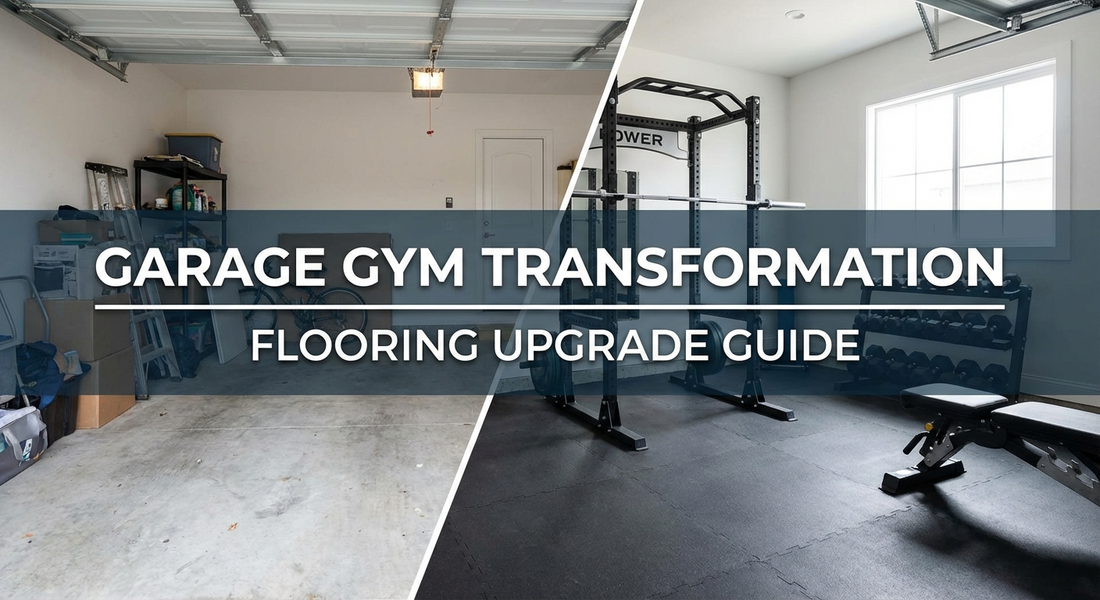
Garage Gym Transformation and Flooring Upgrade Guide
Share
How do you transform a garage into a functional home gym?
Transforming your garage into a home gym requires proper planning, quality flooring, and the right equipment selection. The key steps include clearing and cleaning the space, installing protective flooring, ensuring adequate ventilation, and choosing durable remanufactured commercial equipment that can withstand garage conditions.
Your garage represents one of the most versatile spaces for creating a serious home gym. Unlike cramped spare bedrooms or basement spaces, garages offer the ceiling height and floor space needed for Olympic lifting, cardio equipment, and full-body workouts. However, the transformation requires careful attention to flooring, climate control, and equipment selection to create a space you'll actually want to use year-round.
What type of flooring works best for garage gyms?
The best garage gym flooring combines rubber mats, interlocking tiles, or epoxy coatings depending on your workout style and budget. Rubber flooring costs $2-8 per square foot and provides excellent shock absorption. Epoxy coatings run $3-12 per square foot but offer easy cleaning and durability against heavy equipment.
Rubber Flooring Options
Rubber flooring remains the gold standard for home gyms because it:
- Absorbs impact from dropped weights and jumping exercises
- Provides excellent traction for lifting and cardio
- Resists moisture and temperature fluctuations
- Reduces noise transmission to neighbors
- Easy to clean and maintain
Epoxy Coating Benefits
Professional epoxy coatings offer several advantages:
- Creates a seamless, professional appearance
- Resists stains, chemicals, and moisture
- Easy to sweep and mop
- Reflects light to brighten the space
- Increases property value
How much does a garage gym transformation cost?
A complete garage gym transformation costs $2,000-$8,000 depending on flooring choice, climate control needs, and equipment selection. Basic transformations with rubber mats and essential equipment start around $2,000, while premium setups with epoxy floors and commercial-grade cardio equipment can exceed $10,000.
| Budget Level | Flooring | Equipment | Total Cost |
|---|---|---|---|
| Basic | Rubber mats ($300-600) | Rack, barbell, plates ($1,500-2,500) | $2,000-3,500 |
| Mid-Range | Interlocking tiles ($800-1,200) | Plus cardio machine ($3,000-5,000) | $4,000-7,000 |
| Premium | Epoxy coating ($1,500-3,000) | Commercial equipment ($5,000+) | $8,000-15,000 |
What equipment works best in garage gym environments?
Garage gyms require equipment that can handle temperature fluctuations, humidity, and dust exposure. Remanufactured commercial equipment often performs better than consumer models because it's built for heavy use and varying conditions. Look for equipment with sealed bearings, powder-coated finishes, and robust construction.
For cardio equipment, consider these garage-friendly options:
- StairMaster HIIT Air Bike - Air-cooled resistance handles temperature changes well
- Life Fitness CLST Integrity Series Treadmill - Commercial-grade construction for durability
- Precor EFX 835 Total Body Elliptical Trainer - Sealed bearings protect against dust and moisture
How do you control temperature and humidity in a garage gym?
Temperature and humidity control in garage gyms requires insulation, ventilation, and sometimes climate control systems. Basic solutions include adding insulation ($1-3 per square foot), installing ventilation fans ($200-500), and using dehumidifiers ($150-400). More comprehensive systems with mini-splits can cost $2,000-5,000 but provide year-round comfort.
Essential Climate Control Steps
- Insulate the garage door - Reduces heat transfer significantly
- Add wall insulation - Critical for temperature stability
- Install ventilation fans - Removes humid air and odors
- Consider a mini-split system - Provides heating and cooling
- Use a dehumidifier - Protects equipment from rust and corrosion
What are the key planning considerations for garage gym layout?
Effective garage gym layout prioritizes workflow, safety clearances, and multi-use functionality. Plan for 8-foot ceilings minimum for Olympic lifting, 3-foot clearances around cardio equipment, and designated zones for different workout types. Consider preserving car parking space with fold-away or wall-mounted equipment where possible.
Zone-Based Layout Strategy
- Lifting Zone: Power rack, barbells, plates near the back wall
- Cardio Zone: Treadmill, elliptical with TV viewing angle
- Functional Training: Open floor space with mats for bodyweight exercises
- Storage Zone: Wall-mounted racks for accessories and equipment
Frequently Asked Questions
Can I still park my car in a garage gym?
Yes, many homeowners create dual-purpose garages using fold-away equipment, ceiling-mounted storage, and designated parking zones. Wall-mounted racks and compact equipment like the Precor AMT-12 865 Adaptive Motion Trainer maximize floor space efficiency.
How long does a garage gym flooring installation take?
Rubber mat installation takes 1-2 days for DIY projects. Professional epoxy coating requires 3-5 days including surface prep, application, and curing time. Weather conditions can extend epoxy curing times.
What's the best flooring for heavy deadlifts and Olympic lifting?
Heavy lifting requires 3/8" to 3/4" rubber mats or specialized lifting platforms. Epoxy alone isn't sufficient for dropped weights - combine it with rubber mats in lifting zones for optimal protection.
Do I need permits for a garage gym conversion?
Most garage gym conversions don't require permits since you're not changing the structure. However, electrical work for new outlets, lighting, or climate control may require permits depending on local codes.
How do I prevent equipment rust in a garage environment?
Control humidity with dehumidifiers, ensure good ventilation, and choose equipment with corrosion-resistant finishes. Remanufactured commercial equipment often features better protective coatings than consumer models, making it ideal for garage environments.


